ORAKEM / Insights
Cycles of concentration: the cooling tower number that controls your water bill
One ratio decides how much water your tower wastes as blowdown. Here is how it works and how far you can safely push it.
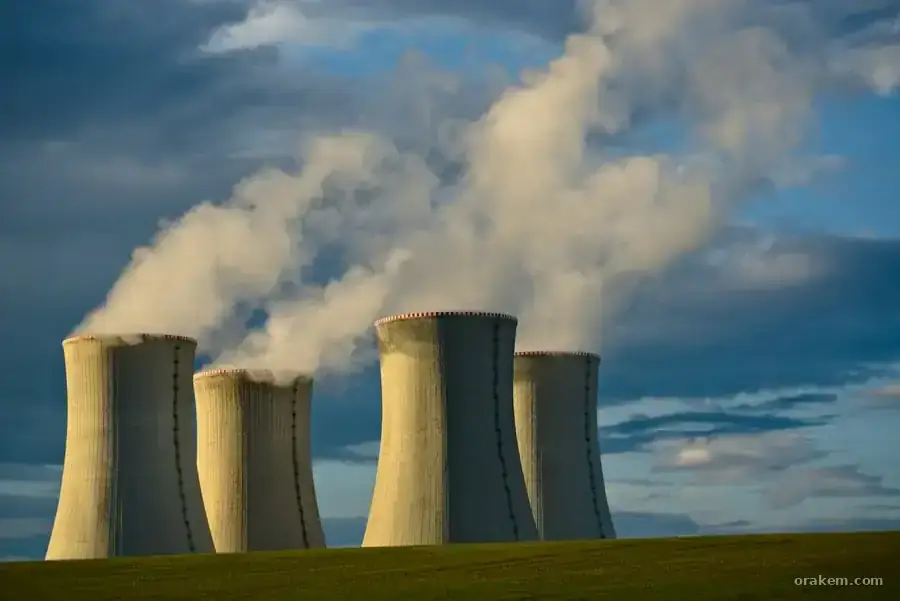
Every cooling tower loses water in three ways: evaporation, which does the cooling; drift, the fine droplets carried out with the air; and blowdown, the water drained on purpose to stop dissolved salts building up. Evaporation is set by the heat load. Blowdown is the part you control, and cycles of concentration are how you control it.
Cycles of concentration compare the dissolved solids in the circulating water with those in the make-up. If the make-up has a conductivity of 500 µS/cm and the tower water reads 2,500 µS/cm, the tower is running at 5 cycles. Chloride or silica ratios give the same answer and are useful cross-checks.
Blowdown equals evaporation divided by cycles minus one. At 2 cycles, blowdown equals evaporation. At 5 cycles, it falls to a quarter of evaporation. Raising cycles from 3 to 6 cuts blowdown by about 60% and total make-up by about 20%, for the same cooling.
In the Gulf, where make-up is often desalinated water or TSE and towers run hard all summer, that difference is a large share of the water and sewage bill.
Our cooling tower savings tool gives an indicative figure for your own tower. A site survey turns it into a target you can hold.
Send us your water analysis or operating data. An engineer replies within one working day.
Last updated November 2026
This website is operated by ORAKEM, United Arab Emirates ([email protected]). We act as the controller of the personal data described here.
Only what you send us through the contact and request forms or by e-mail: your name, company, e-mail address, country and the details of your enquiry, including any water analysis you share. The site does not use advertising or tracking cookies. Your language choice is stored in your own browser.
To answer your enquiry, prepare proposals and documents you request, and manage an existing business relationship. We do not sell personal data or use it for unrelated marketing.
Form messages are delivered by a form-delivery service and stored in our business e-mail (Microsoft 365). The site is hosted by Cloudflare. These providers may process data outside the UAE under their own safeguards.
Enquiries that do not lead to business are deleted within 24 months. Records of customers and suppliers are kept as long as UAE commercial and tax law requires.
You can ask to see, correct or delete your personal data, or object to its use, under the UAE Personal Data Protection Law (Federal Decree-Law No. 45 of 2021). Write to [email protected] and we will reply within 30 days.
Last updated November 2026
Content on this website is general information about our products and services. It is not a specification, an offer or engineering advice for a particular system.
Calculator results are indicative estimates from simplified models. Decisions about dosing, operation or investment should be based on a site survey and a written ORAKEM proposal.
Product availability, grades and specifications may change without notice. Every sale is governed by our quotation, order confirmation and terms of sale, and by the Technical and Safety Data Sheets supplied with each product. Some products are supplied only to licensed or qualified buyers in line with UAE regulations.
The ORAKEM name, logo, texts, graphics and tools on this site belong to ORAKEM. You may not copy or reuse them without our written permission.
To the extent permitted by law, ORAKEM is not liable for any loss arising from use of this website or reliance on its content.
These terms are governed by the laws of the United Arab Emirates.